SHOSHONE PINAQUANA (CHIEF WASHAKIE) DIED
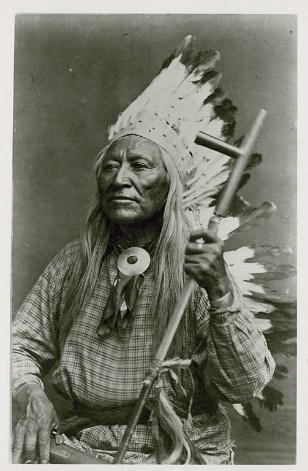
Born circa 1804 to his father’s tribe in the Bitterroot Valley, Montana, his Umatilla name meant “Smells like sugar.” He became “Washakie” upon joining his mother’s Shoshone tribe. Washakie learned French & English from trappers and spoke several Native American languages. After trapper Jim Bridger (later his son-in-law) convinced him to lead a Shoshone delegation to the 1851 Treaty of Fort Laramie, the U.S. deemed him head of the Eastern Shoshones. A famed warrior, in 1866, he fought Crow Chief Big Robber 1-on-1 and, victorious, displayed his foe’s heart on a lance. With the influx of settlers, he signed treaties at Fort Bridger, Wyoming, in 1863 & 1868, preserving over 3 million acres for the Shoshone. Washakie helped General Crook in the Great Sioux War of 1876 and, in 1878, an army post on the reserve was renamed Fort Washakie. Upon his death there, he received a full military funeral. In 1979, Washakie was inducted into the Hall of Great Westerners of the National Cowboy & Western Heritage Museum.
Sources:

“Chief Washakie Statue,” U.S. Capitol for Wyoming, Architect for the Capitol.  Retrieved 10/19/2022,    Chief Washakie Statue, U.S. Capitol for Wyoming | AOC

“Washakie: Shoshone chief,” Britannica.  Retrieved 10/19/2022, Shoshone | people | Britannica

Wikipedia

Photo:  Baker and Johnson, pre-1900.  Washakie, a Shoshoni chief holding a catlinite pipe. Public Domain.  Source:  National Anthropological Archives, Smithsonian Institution, SPC Basin Shoshoni BAE 4423 #35-40 00869600
 Indigenous America Calendar